StorySitting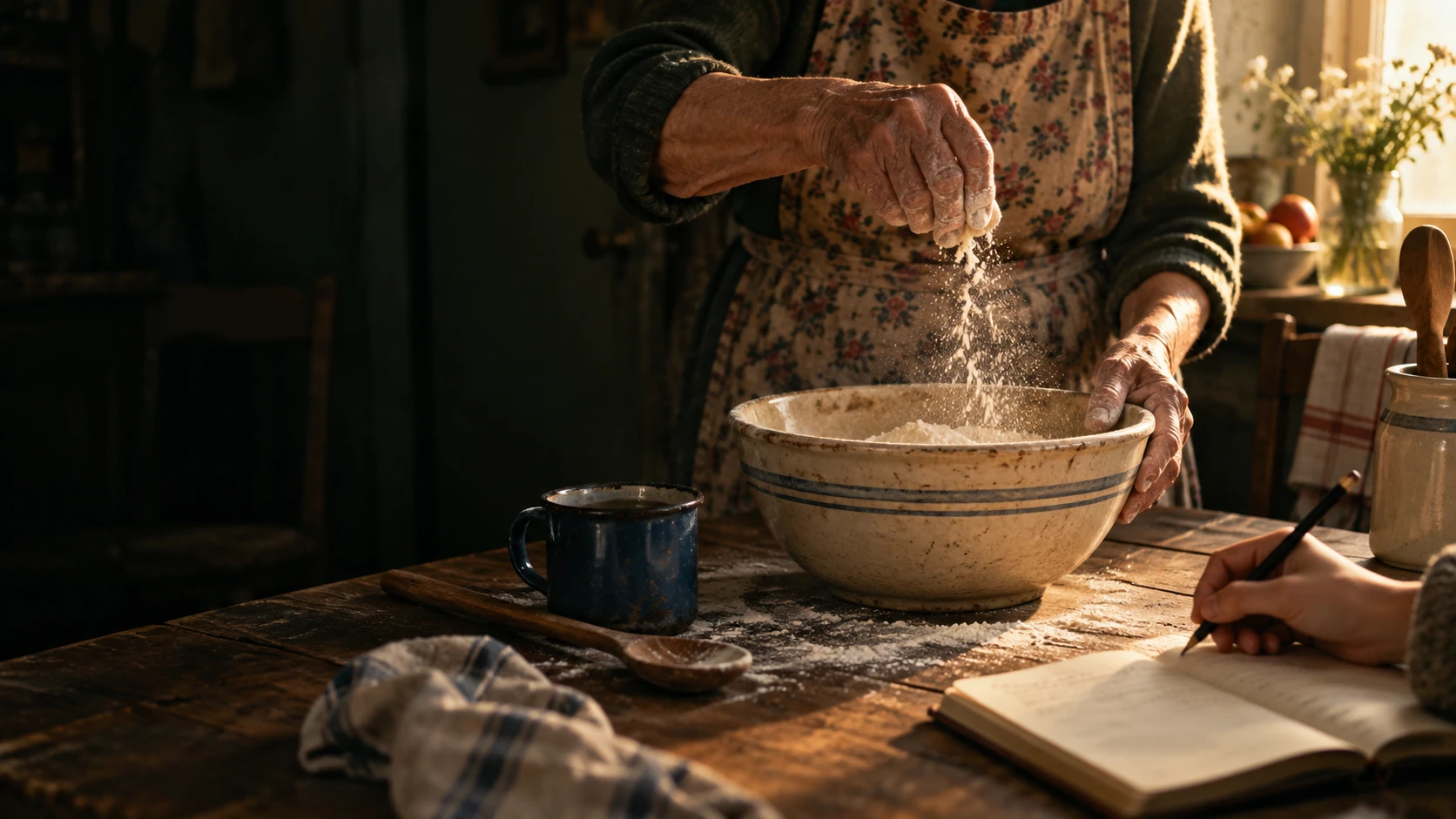
Start with one dish, not the whole recipe box
“Will you write down all your recipes?” is a project. “Can you show me how you make those dumplings next Saturday?” is an invitation. Choose one dish you actually want to cook. Bring the ingredients if that helps, and offer to wash up.
Your job is to do the writing. Let the person who knows the recipe cook in their usual way. A notebook, measuring spoons, a kitchen scale if you have one, and the free worksheet are enough to begin. If you want photos, video or audio, ask before recording and agree on who can have a copy.
If cooking together isn't possible, ask them to walk through one recipe while you take notes. Mark the parts you still need to see demonstrated. A conversation can get you started without pretending it captures every movement of their hands.
Catch the measurements without taking over
When the instruction is “a little flour,” the useful question is “Could we measure that amount once, so I can try it at home?” Keep their familiar language beside the measurement. “One blue mug, filled to here” may be part of the memory; the measured amount makes it easier to repeat with a different mug.
- Weigh the usual handful. Ask them to put it in a bowl on a zeroed scale before adding it. Write down what you observed, including the ingredient.
- Identify the spoon. A tablespoon measure and a spoon from the cutlery drawer aren't the same reference. Note whether it was level, rounded or heaped.
- Record the ingredient's state. Whole or chopped? Fresh or dried? Butter straight from the fridge or softened? Write down what actually went into the pan.
- Keep additions separate. If more liquid goes in later, record that step instead of folding everything into one unexplained total.
You are documenting this particular batch. An approximate amount should stay marked approximate until you've tried it yourself. If measuring interrupts a delicate step, let them finish and ask afterward.
Write down the clues the recipe leaves out
A list of ingredients won't tell you how the mixture should feel or which pan they always use. Look for the decisions between the steps: when they turn the heat down, what they wait for, and how they know something needs adjusting.
Ask while they work
- What are you looking for before you add the next ingredient?
- Can you show me the texture you mean?
- Which pan do you use, and does a different one change anything?
- What usually goes wrong when someone makes this for the first time?
- What do you change when you make a smaller batch?
Write down the oven setting or heat level, the pan's size, and the time you actually observed. Keep their visual or texture cue alongside it. The worksheet preserves a family method; it is not a food-safety test. Use appropriate food-safety guidance when deciding whether food is safely cooked or stored.
Save the story beside the instructions
Once there is a quiet moment, ask about the dish's place in the family. Who taught them? Was it everyday food or something made for visitors? Did the recipe change after a move, a tight-budget year, or an ingredient becoming hard to find?
These details belong beside the recipe, not in a separate folder you'll struggle to find. Keep a line in their own words if they are happy for you to share it. A dish can have more than one family version; label whose version you're recording instead of declaring a winner.
For example, a useful title is “Auntie's Sunday dumplings — the version she showed me in September,” rather than “The original family recipe.” The first says what you actually know.
Try cooking from your notes
Make the dish again using only what you wrote down. Each moment you have to guess tells you where the notes need work. Did “a tin” mean a particular size? Was the lid on? Were the onions already cooked?
Bring back a small list of questions rather than asking them to start over. Keep the original notes and add a dated revision. If your equipment or ingredients differ, record your changes separately so another family member can tell which instructions came from whom.
Here is a fictional example of a note revision: “Add milk until it looks right” becomes “In the batch we made together, 120 ml went in first, then two more tablespoons. She stopped when the mixture fell slowly from the spoon.” That is an observation, not a complete or tested recipe.
Make a copy someone can actually use
Put the ingredient list, numbered steps and story on adjoining pages. Add a photo of the finished dish if you have permission, and include the cook's name, the date and who took the notes. Keep the rough recording or photos alongside the finished version.
Save a second copy somewhere separate from the device you used to make it. Send the cook a readable copy to correct. Before putting it online or in a wider family book, check that they're comfortable sharing both the recipe and the story.
Download the free two-page recipe worksheet. It leaves room for ingredients, method, the cook's own cues, family memories and a second-attempt check. No email needed.
A little more help
For the wider conversation, try our 52 questions for parents and grandparents, or start gently with someone who says they have no stories.
Further reading: the Smithsonian Folklife and Oral History Interview Guide discusses documenting family traditions, including using photographs to capture processes such as cooking. The cook-along workflow and worksheet here are StorySitting's own practical suggestions.